As I noted in an introduction to this site, I’m not a film studies professor. I have no formal academic training in the history or technique of film, unless a single, memorable undergraduate class counts — and it doesn’t. But that was the class that turned me into a cinephile, that enabled me to see the richness and depth of cinematic tradition, and also to see its possibilities as an art form. Above all, I’ve continued to watch films — many, many films, the best of them repeatedly. And I have read extensively about cinematic art and technique — and about the economics of the business (which interests me strangely).
I have only written about film occasionally, and have only taught films occasionally. But I do write a lot, and I also teach a lot, and so over the years it has added up. My experience as both a writer about and a teacher of cinema is, by this point, not inconsiderable.
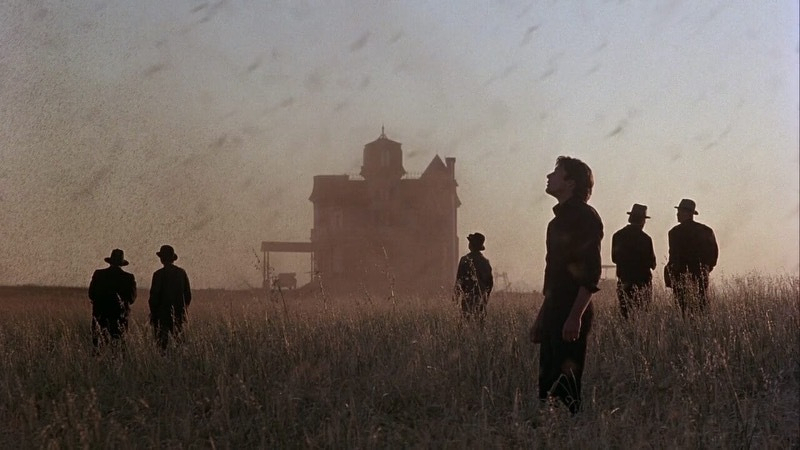
But it really wasn’t until Josh Jeter, Malick’s chief of staff, invited me to watch a cut of the work then in progress, later to be called A Hidden Life — an experience that I’ve written about here — that film started moving closer to the center of my interests. Aside from Malick, my focus is especially on films made in the period that is my scholarly home, which is essentially the middle third of the 20th century; so, you might say, from Chaplin’s Modern Times to Kubrick’s 2001. That covers a lot of ground, of course. But I do know that territory very well.
And I want to note here that mid-century films were fundamentally formative for Malick, something which he talked about often in the days when he was still giving interviews.
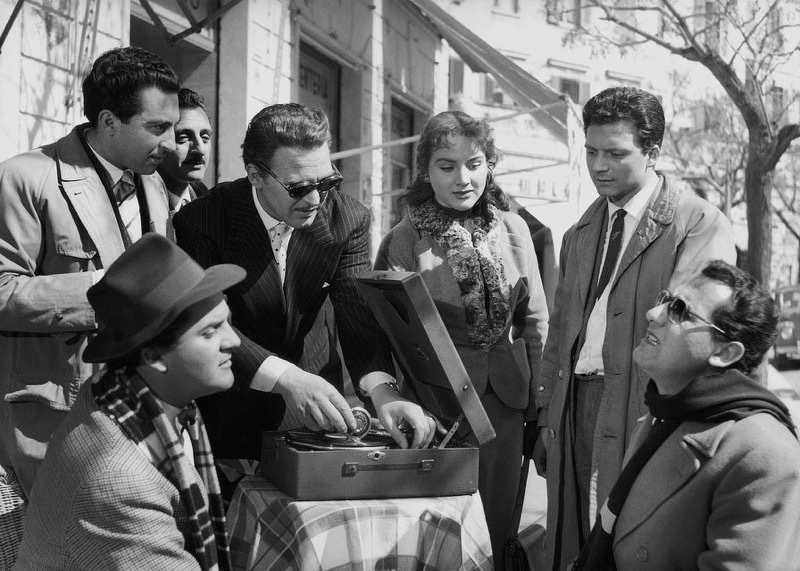
Two major traditions are essential for understanding the filmmaker he became. One is the Italian neorealist cinema. Malick adores the early Fellini, especially The White Sheik (1952) and I Vitelloni (1953). He adores Rossellini, especially Voyage to Italy (1954). But then he also loves Elia Kazan and William Wyler and the massive widescreen blockbusters they made in the early years of Cinerama and CinemaScope. (Foster Hirsch’s Hollywood and the Movies of the Fifties is great on the development of these technologies.)
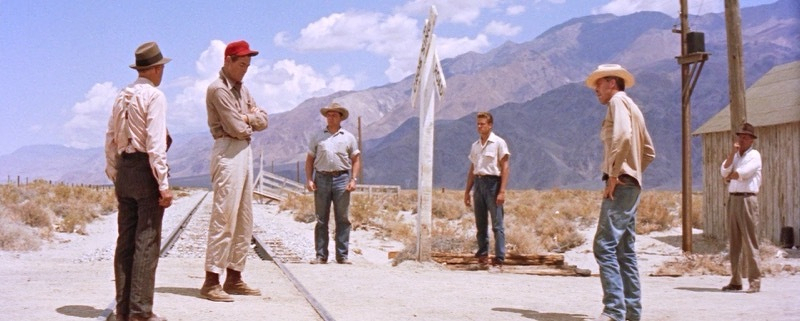
And I believe — I don’t know that Malick has ever said this, but I am convinced — that there’s a good bit of John Sturges in Malick’s directorial DNA. P.T. Anderson has said — it’s a claim that has become notorious among cinephiles — that you could learn more from listening to John Sturges’s commentary on his 1955 film Bad Day at Black Rock than you could learn in twenty years of film school. And that commentary — here and here — is actually very interesting and wide-ranging. Bad Day at Black Rock is one of the very first CinemaScope films, and Sturges is the director who first figured out how you could make that wide aspect ratio work for you as a serious storyteller. It required thinking in new ways about composition, and (Sturges thought) about the freedom of the viewer to direct his or her attention.
But I digress … a little. We’ll return to some of this material in future posts.
In any case, those are the two major strands of influence on Malick: Italian neorealist cinema in black & white, with its emotionally intense explorations of (especially) family life; and the intensely colorful widescreen Hollywood films of the 1950s, especially by Kazan and Sturges. And I think if you put together sweeping dramatic landscapes and emotionally intense depictions of family life, well, then you kind of have Days of Heaven, The Tree of Life, and A Hidden Life, don’t you?
And Malick brings these influences together in his own inimitable way. Many years ago, when I was living in Chicagoland, I subscribed to Chicago magazine, my favorite part of which was the restaurant reviews. Each issue featured capsule reviews of dozens and dozens of restaurants, each of which had a tag to suggest the type of restaurant it was: Mexican or Italian or Thai or whatever. And then when you got to Charlie Trotter’s, the tag was: Trotter’s cuisine. What Trotter was doing was so distinctive, so unlike what anyone else was doing, that that was the only thing you could call it. And exactly the same is true of the movies Terrence Malick makes: it’s Malick’s cinema, indescribable by any conventional terms, within any conventional categories. You just have to get to know it.
And I have gotten to know it very well. Most of that is a result of my simply watching the movies over and over again with a notebook in my lap, pausing occasionally to respond (with timestamps). I’ve been willing to do that over and over.
However, it’s also true that when I got to see the cuts of A Hidden Life, I was introduced to The Process. I saw four versions of it, and while I am forbidden (by an NDA) to discuss the details of my experience, I can say this much: observing how the story developed, seeing and hearing (Malick’s films are as much aural as visual) the effects of editing, seeing and hearing the ways in which even seemingly small alterations can have massive reverberations, and then talking about everything with Malick and his editors — all that was extraordinarily illuminating. And I feel that that experience gave me a kind of right-brain, that is to say, genuine but not wholly expressible, insight into the gestalt of Malick’s cinema.
It’s also true that Terry Malick and I have become friends in the years since then; I see him fairly regularly. But when we talk, we say very little about his movies, past or present. There are two reasons for that. One is that I figure he could use a mental break from his work. The other is that Terry is never Terry’s preferred topic of conversation. Like many artists, he doesn’t want to get overly analytical about what he does, because that doesn’t help. But also, he’s just not focused on himself. He’s more interested in the world, in other people. The last time I got together with him, the main thing he wanted to talk about was my recent biography of Paradise Lost, which he had just read and loved. (Maybe I shouldn’t say that, but I am frail. That one of the greatest living artists enjoys my writing makes my head swim a little. Sue me.) We talk about books, about the Monterey oaks we’ve planted in our respective yards, about unusual birds we have recently seen, about new cameras and new lenses that he’s been fooling around with. (As someone who knows him well has said to me: “Terry’s a gearhead.”) On occasion we sing together verses of hymns.
I can’t claim that getting to know Terry has led to the revelation of secrets about his filmmaking that I can then put into my own words and post here on the site. It’s not like that. I do think that getting to know him has given me a feel for the work, but I’m not certain about that. And he has never, at any point, said anything remotely like “What I was trying to do in this scene was X.” And so, while getting to know him makes a difference to how I see his movies and how I’m going to be writing about them, it doesn’t do so in a way that I can specify. And now that I’m done with this blog post, I’m not going to say anything about it again.