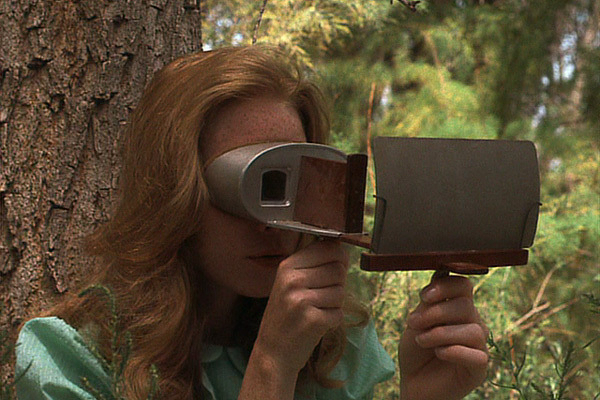
In Malick’s first film, Badlands, a teenage girl named Holly – having run away with a charming young man named Kit who has murdered her father – finds herself hiding out with Kit in the woods. She has brought along a few souvenirs of her previous life, including a stereopticon that had belonged to her father. As the images pass before our eyes, we hear her soliloquy:
One day, while taking a look at some vistas in Dad’s stereopticon, it hit me that I was just this little girl, born in Texas, whose father was a sign painter and who had only just so many years to live. It sent a chill down my spine, and I thought, Where would I be this very moment if Kit had never met me? Or killed anybody? This very moment? If my Mom had never met my Dad? If she’d have never died? And what’s the man I’ll marry gonna look like? What’s he doing right this minute? Is he thinking about me now, by some coincidence, even though he doesn’t know me?
One of the images we see as we listen to Holly is a photograph of the Great Sphinx of Giza – so we call that monumental statue, though we do not know what its makers called it, and it differs in some respects from the Sphinx of Greek myth. That myth tells us that the Sphinx was a monstrous creature – with a lion’s body, a serpent’s tail, an eagle’s wings, and the face of a woman – who dwelt near the city of Thebes and posed riddles to travelers. Those who could not answer the riddles she killed and consumed. And so we are reminded that Holly, though a traveler, is her own Sphinx, posing questions to herself that she cannot answer. The past cannot be rewritten; the future cannot be known. (But it is interesting that Holly assumes both that she will one day be married and that her future husband will not be Kit.)
This image of the Sphinx leads us down curious paths. In 1840 Ralph Waldo Emerson wrote a poem that he believed so central to his own imaginative world that he placed it at the beginning of every collection of his poems published in his lifetime. The poem is called “The Sphinx,” and it is famously inscrutable. What can we say with confidence about it?
Not much, to be honest. But first, that it begins with the Sphinx asking, “Who’ll tell me my secret / The ages have kept?” This secret concerns “The fate of the man-child; / The meaning of man.” There is a mystery about humanity because – unlike the other creatures, who are “By one music enchanted, / One deity stirred” – humans behave in strange and contradictory ways:
But man crouches and blushes,
Absconds and conceals;
He creepeth and peepeth,
He palters and steals;
Infirm, melancholy,
Jealous glancing around,
An oaf, an accomplice,
He poisons the ground.
That is, human beings are uniquely divided from the rest of the world – and know it. We don’t act honestly and straightforwardly; we blush, we are jealous; we’re not only lamentably distinct from the rest of nature, we are also internally divided.
The Sphinx’s discourse is interrupted by a poet who is said to speak “cheerfully,” I think – here we cease to be able to speak confidently – I think because he simply reframes the Sphinx’s mournful description of our dividedness as a series of paradoxes which he wishes to embrace. But critics and readers are divided on these matters, and we are left with many questions. Is the poet correct in his reframing, or tragically over-optimistic? When the Sphinx tells the poet to “take thy quest through nature,” does this counsel contain a reprimand? Why is the Sphinx suddenly “merry”? (“Up rose the merry Sphinx,” Emerson writes.) These questions are perhaps as unanswerable as Holly’s, especially since Emerson forcefully denied his own ability to answer anything: “Do not set the least value on what I do, or the least discredit on what I do not, as if I pretended to settle anything as true or false. I unsettle all things. No facts are to me sacred; none are profane: I simply experiment, an endless seeker, with no Past at my back.”
Here we might reflect that, thanks to his refusal to explain himself and his work, his refusal even to give interviews, Terrence Malick has been called a recluse, a hermit — and, more portentously, a riddling Sphinx. Pico Iyer, one of Malick’s most insightful commentators, writes: “How can one not be fascinated with the great sand-blown Sphinx of modern filmmaking, Terrence Malick?” This endless seeker.
(But is he really so inscrutable?)
Throughout Emerson's poem, the Sphinx speaks of “Man” as a single being with a single character. When she says to the Poet, “I am thy spirit, yoke-fellow, / Of thine eye I am eyebeam,” and calls him “thou clothed eternity,” she is clearly not describing this individual person but rather Man as a species. That Man is a single being is one of Emerson’s most pervasive themes: He opens his essay “History” by affirming that “There is one mind common to all individual men. Every man is an inlet to the same and to all of the same.” In “The Over-Soul” he rhapsodizes on
that great nature in which we rest, as the earth lies in the soft arms of the atmosphere; that Unity, that Over-soul, within which every man’s particular being is contained and made one with all other; that common heart, of which all sincere conversation is the worship, to which all right action is submission; that overpowering reality which confutes our tricks and talents, and constrains every one to pass for what he is, and to speak from his character, and not from his tongue, and which evermore tends to pass into our thought and hand, and become wisdom, and virtue, and power, and beauty. We live in succession, in division, in parts, in particles. Meantime within man is the soul of the whole; the wise silence; the universal beauty, to which every part and particle is equally related; the eternal ONE.
In Malik’s third movie, The Thin Red Line (1998), we hear American soldiers on the island of Guadalcanal in the Second World War, meditating on just this idea: the possibility that all of us are a single entity. I wrote about that idea in this post, one in a series about the Battle of Guadalcanal.
