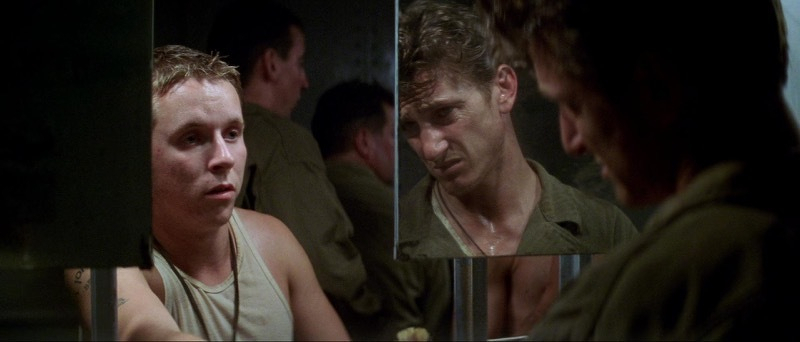
Terrence Malick is a biblically literate man — to say the very least — but Holy Scripture in his films often is mediated through theological and spiritual sources. I’ll be writing about some of those in later posts, but here are a few examples:
- The apocalyptic visions in Linda Manz’s voiceover at the end of Days of Heaven
- The contrast between Nature and Grace at the beginning of The Tree of Life
- The prayers of Javier Bardem’s priest in To the Wonder
- John Gielgud’s recitation of the opening sentences of The Pilgrim’s Progress at the beginning of Knight of Cups
Sometimes the biblical text is intriguingly buried, as when, in Song to Song, a movie in which Patti Smith appears as a counselor to one of our protagonists, we hear in the background her amazing song “My Blakean Year” — which contains these lyrics:
So throw off your stupid cloak
Embrace all that you fear
For joy shall conquer all despair
In my Blakean yearMercy hath a human heart
Pity a human face
Love a human form divine
And Peace a human dress
I leave the discovery of the biblical roots of those lines as an exercise for my readers.
Even in A Hidden Life the Bible is not foregrounded. You have to pay attention to the echoes in the language of the characters — something I will do in a future post.
But there’s an interesting exception to this reticence, and it comes in The Thin Red Line. That film, like all of Malick’s, makes extensive use of voiceover, but it’s unique in the number of voices we hear. Usually Malick provides a visual link: we see a character, and then we hear his voice, according to the cinematic grammar of mental soliloquy that I believe was pioneered by Laurence Olivier in Hamlet (1948): see this scene for example.
But on several notable occasions that visual link is not provided. For instance, the opening soliloquy —
What’s this war in the heart of nature? Why does nature vie with itself — the land contend with the sea? Is there an avenging power in nature? Not one power, but two?
— and this, from two hours in:
This great evil … where’s it come from? How’d it steal into the world? What seed, what root did it grow from? Who’s doin’ this? Who’s killin’ us? Robbin’ us of life and light. Mockin’ us with the sight of what we might have known. Does our ruin benefit the earth? Does it help the grass to grow, the sun to shine? Is this darkness in You, too? Have You passed through this night?
— and these final words of the film:
Where is it that we were together? Who were you that I lived with? The brother. The friend. Darkness, light. Strife and love. Are they the workings of one mind? The features of the same face? Oh, my soul. Let me be in You now. Look out through my eyes. Look out at the things You made. All things shinin’.
— are uttered by the same voice.
Most viewers seem to think that the voice is that of the story’s central character, Jim Caviezel’s Private Witt, but it’s not. They’re fooled by two (actually rather distinct) Southern accents. The speaker is an apparently minor character, Private Edward Train, who is played by a non-professional actor named John Dee Smith. (For the details, see this essay, originally published in the journal Post Script.)
Train is sufficiently minor that in the movie’s Wikipedia page he isn’t mentioned, but in an important sense he’s not minor at all: he’s at the heart of the movie.
A few minutes after that initial voiceover, we meet Train, on a troop ship headed for Guadalcanal, and he’s in a panic. He’s terrified, and he’s telling Sergeant Welsh (Sean Penn) all about it — or rather he’s telling anyone who’ll listen, and Welsh is listening. Other soldiers look and then look away. Train says that the ship is a “floating graveyard,” that they’ll all die, that when they’re dropped off the troop ship they’ll probably not even make it onto the beach.
(This was a common fear among soldiers coming to Guadalcanal, because they expected it to be desperately defended by the Japanese, but as it turned out the Japanese withdrew into the center of the island and the landing was virtually unopposed. There was no way for anyone to anticipate that, however.)
Train tells Welsh: “The only things that are permanent is, is dyin’ and the Lord. That’s it.” He then, in his distress, remembers the faith that he has been taught: “This war ain’t gonna be the end of me, and [looking up and pointing at Welsh] it ain’t gonna be the end of you neither.”
At this point we might notice that Train has a tatto on his bicep, which reads, in conveniently large letters: 1 JOHN 4:4. In the King James version that a Southerner in 1943 would certainly have used: “Ye are of God, little children, and have overcome them: because greater is he that is in you, than he that is in the world.”
Train here expresses the fears that they all have but know better than to say out loud. That’s why he makes them uncomfortable. It’s as though everything they have suppressed finds its outlet through him. He fulfills this function again at the end, when those who have survived are on another troop ship, taking them to safety: “Well, I figure after this the worst is gonna be gone.” (Look at the framing of that shot at the top of the page: Train as a mirror to Welsh. Notice also how the tattoo is hidden: it’s only as the conversation develops that it becomes visible.)
Perhaps it is true, after all, that Private Train has overcome, that “greater is he that is in you, than he that is in the world.” That first troop ship was not a floating graveyard … at least, not for him. But for others the story is different, and darker. Could those who perished have thought, in their dying moments, that they had in some vital sense overcome, thanks to the Christ who is in them and who is greater than the one who brought into the world “this great evil”?
One may hope. Perhaps Train also hopes, especially since he knows that he is connected in some permanent way with the “brothers” he lived and fought with — and that all of them are connected in some equally permanent way to Creation. (I wrote a bit about these connections here.) Train has gone into Hell and has passed through, he has come out the other side; and he bears witness to, indeed is a part of, those who fought, on both sides; and further he bears witness to the glory of Creation that persists despite our worst efforts: as Auden puts it, “The order we try to destroy, the rhythm / We spoil out of spite.” As Private Train puts it: All things shining.
At this point I recall a famous passage from The Gulag Archipelago:
All the writers who wrote about prison but who did not themselves serve time there considered it their duty to express sympathy for prisoners and to curse prison. I… have served enough time there. I nourished my soul there, and I say without hesitation:
“Bless you, prison, for having been in my life!”
People, especially Christians, love to quote that passage. But they tend to leave out what comes next, even though what comes next is precisely what marks Solzhenitsyn as a great writer:
(And from beyond the grave come replies: It is very well for you to say that — when you came out of it alive!)
