I often think of one of Auden’s great early poems, titled in later collections “A Summer Night” but originally called by its first line: “Out on the lawn I lie in bed.” It is based on a real experience, one that I wrote about in some detail here. Auden is enjoying the company of colleagues and musing on, among other things, the great question of why he should be so blessed.
At one point he imagines the moon rising and then looking down upon him and indeed upon the whole world:
To gravity attentive, she
Can notice nothing here, though we
Whom hunger cannot move,
From gardens where we feel secure
Look up and with a sigh endure
The tyrannies of love:And, gentle, do not care to know,
Where Poland draws her eastern bow,
What violence is done,
Nor ask what doubtful act allows
Our freedom in this English house,
Our picnics in the sun.
Why should we be among the fortunate “Whom hunger cannot move?” When others are facing the fiercest tyrannies, why should we be allowed merely to “endure / The tyrannies of love”?
Auden here introduces a counterpoint to his own experience of peaceful blessedness, what he would later call his “vision of agape.” The two themes are juxtaposed to each other, neither victorious, neither dispensable. The blessed and the afflicted.
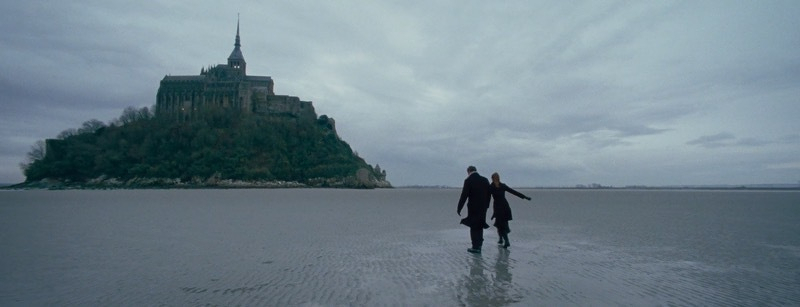
As “Out on the lawn” is a contrapuntal poem, Malick’s To the Wonder (2012) is a contrapuntal film. Neil, Marina, and Jane endure the tyrannies of love — and they are tyrannies, the suffering of all these people is real and affecting. But through the scenes involving Javier Bardem’s Father Quintana we are introduced to a very different world: a world of poverty, illness, sin, guilt, grief — affliction of the most tangible kinds.
Father Quintana’s daily life of service and intercession serves as a powerful counterpoint to the first theme, which is (as the critics said when the film came out) a “romantic drama.” But in a way a romantic drama is what it is not, because the narrative is so obscured and fractured. It’s better to think of the entire movie not as a narrative at all, but rather a contrapuntal musical composition, in which each major theme has a series of motifs that are stated, developed, and recapitulated, almost in classic sonata form — but, again, with counterpoint. It’s the simultaneous presence of these two musical forms (sonata and counterpoint) that makes To the Wonder Malick’s most difficult film to watch. It was not written so much as composed; it is musical to its very bones. And that’s not how movies are usually structured.
(Hanan Townshend, who composed music for the film, has said that Malick has very strong psychological and emotional associations with certain musical changes: "I knew of his wonderful obsession with the tension and release of intervals, particularly the tritone resolving to the fifth as well as singular chords alternating from major to minor.” It’s difficult to overstress how musical Malick’s whole experience of the world is.)

The American scenes in To the Wonder were filmed mainly in Bartlesville, Oklahoma — where Malick lived for a time and where his parents lived for several decades — but the ones featuring Father Quintana’s work among the insulted and the injured were shot not by Malick himself but rather by the eminent photojournalist Eugene Richards. Malick was so committed to counterpoint that he allowed other people to shoot some of the movie’s key scenes.
Richards shot a great deal of footage that did not end up in the final cut of To the Wonder, and in 2018 he released “Thy Kingdom Come,” a 43-minute film taken from that footage. In an interview with the New Yorker, Richards explained that all the people he filmed were told that Bardem was not actually a priest, but rather was playing one in a movie. “Most people knew him as the murderer in ‘No Country for Old Men.’ A couple people knew him as Penelope Cruz’s husband. Some didn’t know who he was at all. And absolutely no one cared, in the end, who he was, except that he was there to listen.”
The stories they have to tell him are often harrowing, and often come from some very deep and dark place within them. Bardem said,
Every time I got into a room with any of them, something magical happened. They would really become a human being sharing, explaining, opening themselves up to a priest. We could go hours recording without stopping because every one of them, what they needed, was to be listened to. I was shocked…. I was not an actor in there. I was there for them, and I had to be empty to be filled with their statements, with their words, with their dreams, with their nightmares.
The everyday clothing of a priest — the black suit, the clerical collar — are signs of two things: attention and absolution. Bardem of course could not pronounce absolution in the proper sense, but for people who are broken and forgotten attention itself is a kind of absolution, a way of saying “You are not beyond the reach of human sympathy; you are part of the human family.”
And who doesn’t need to hear that? It’s noteworthy that the two great musical themes of the movie converge when Neil seeks the counsel of Father Quintana. He endures only “the tyrannies of love,” but again, those are in their own way tyrannies. Father Quintana knows perfectly well that these privileged people — traveling the world, walking through airports, moving in and out of their lovely houses, packing and unpacking, never really settled — don’t experience the gross pains that he sees every day. But he listens to them anyway; it is not his job to compare or to judge. So he prays, for himself as much as for all the others to whom he listens:
Where are you leading me? Teach us where to seek you. Christ, be with me. Christ before me. Christ behind me. Christ in me. Christ above me. Christ on my right. Christ on my left. Christ in the heart. Flood our souls with your spirit and life so completely that our lives may only be a reflection of yours. Shine through us. Show us how to seek you. We were made to seek you.
