Pauline Kael is right about one element of Days of Heaven:
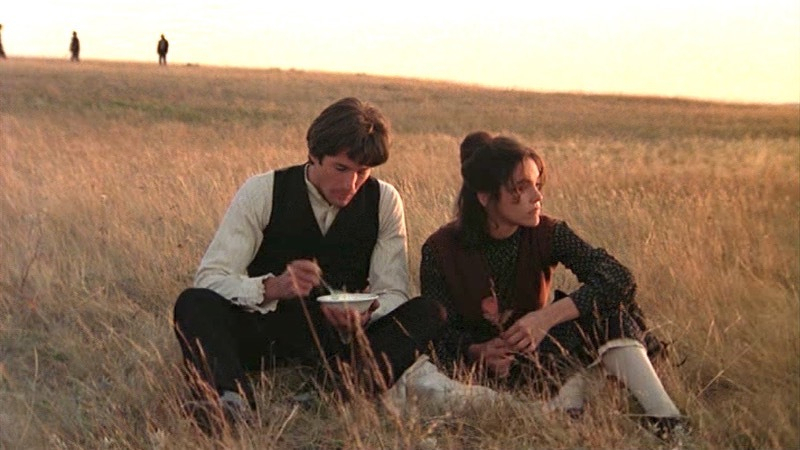
Though the irregularly handsome, slightly snaggletoothed Shepard has almost no lines, he makes a strong impression; he seems authentically an American of an earlier era. But Gere, with his post–50s acting style and the associations it carries of Brando and Dean and Clift and all the others who shrugged and scowled and acted with their shoulders, is anachronistic.
Gere really is the discordant note in this film — in my several viewings of the movie I’ve never really believed in him. But maybe that doesn’t matter too much.
Roger Ebert, revisiting the film 20 years after its release, makes an absolutely brilliant point, the most piercingly accurate thing anyone has ever said about this movie, which is almost always praised only for its great beauty:
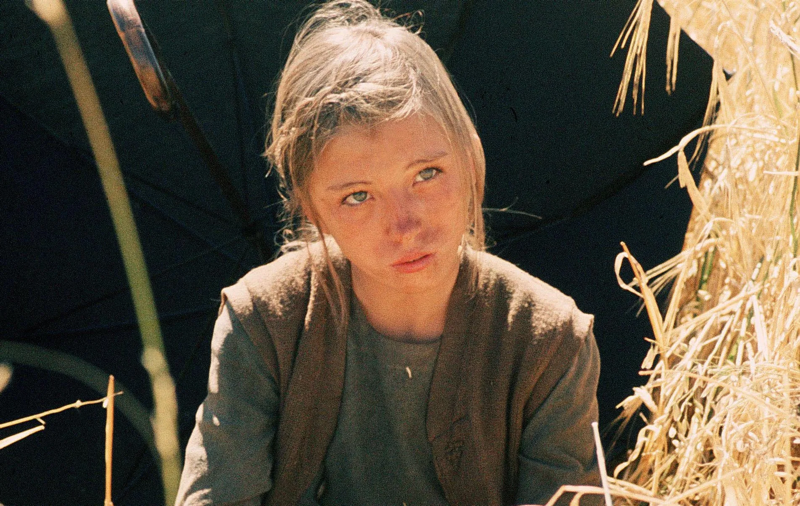
Terrence Malick’s Days of Heaven has been praised for its painterly images and evocative score, but criticized for its muted emotions: Although passions erupt in a deadly love triangle, all the feelings are somehow held at arm’s length. This observation is true enough, if you think only about the actions of the adults in the story. But watching this 1978 film again recently, I was struck more than ever with the conviction that this is the story of a teenage girl, told by her, and its subject is the way that hope and cheer have been beaten down in her heart. We do not feel the full passion of the adults because it is not her passion: It is seen at a distance, as a phenomenon, like the weather, or the plague of grasshoppers that signals the beginning of the end. […]
This child, we gather, has survived in hard times. She has armored herself. She is not surprised by the worst. Her voice sounds utterly authentic; it seems beyond performance. I remember seeing the film for the first time and being blind-sided by the power of a couple of sentences she speaks near the end. The three of them are in a boat on a river. Things have not worked out well. The days of heaven are over. She says: “You could see people on the shore, but it was far off and you couldn’t see what they were doing. They were probably calling for help or something — or they were trying to bury somebody or something.”
That is the voice of the person who tells the story, and that it why Days of Heaven is correct to present its romantic triangle obliquely, as if seen through an emotional filter. Children know that adults can be seized with sudden passions for one another, but children are concerned primarily with how these passions affect themselves: Am I more or less secure, more or less loved, because there has been this emotional realignment among the adults who form my world?
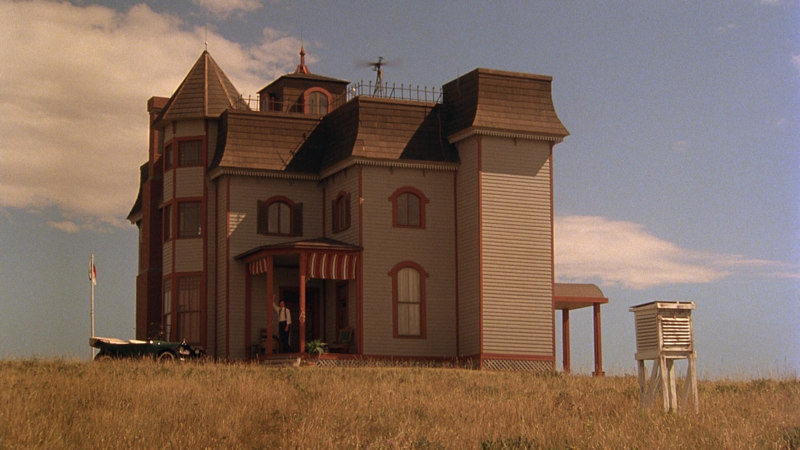
For those of you who have not seen this movie, first of all, I envy you, because it is something to see. I saw it for the first time on its release in 1978, on a date with the woman who would become my wife. It was one of the most powerful of the many cinematic experience we had in those days of darting from university film series to suburban mini-multiplex (the Hoover Four or Green Springs Eight or whatever) to downtown movie palace (the Alabama Theater was built in 1927). We talked about Days of Heaven many times in later years, but almost always we referred to images that had stayed in our minds. The sheer visual glory of the film will probably be foremost in any first-time viewer’s mind, but perhaps Ebert’s words will guide you to a fuller experience.
And if you have seen Days of Heaven before but did not notice what Ebert points out here, I warmly recommend that you see it again.