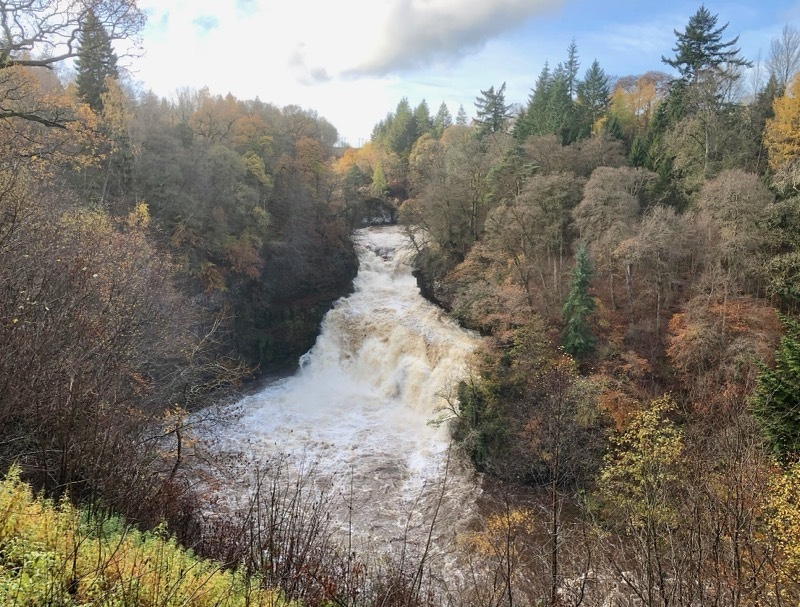
Dorothy Wordsworth, in her Recollections of a Tour Made in Scotland 1803, tells a story:
We sat upon a bench, placed for the sake of one of these views, whence we looked down upon the waterfall, and over the open country, and saw a ruined tower, called Wallace’s Tower, which stands at a very little distance from the fall, and is an interesting object. A lady and gentleman, more expeditious tourists than ourselves, came to the spot; they left us at the seat, and we found them again at another station above the Falls. Coleridge, who is always good-natured enough to enter into conversation with anybody whom he meets in his way, began to talk with the gentleman, who observed that it was a majestic waterfall. Coleridge was delighted with the accuracy of the epithet, particularly as he had been settling in his own mind the precise meaning of the words grand, majestic, sublime, etc., and had discussed the subject with William at some length the day before. ‘Yes, sir,’ says Coleridge, ‘it is a majestic waterfall.’ ‘Sublime and beautiful,’ replied his friend. Poor Coleridge could make no answer, and, not very desirous to continue the conversation, came to us and related the story, laughing heartily.
C. S. Lewis, early in his book The Abolition of Man, describes a textbook that he calls The Green Book, written by two men he calls Gaius and Titius. (The actual book, which is indeed green in the edition Lewis owned, is called The Control of Language and is by Alec King and Martin Ketley.) Lewis:
In their second chapter Gaius and Titius quote the well-known story of Coleridge at the waterfall. You remember that there were two tourists present: that one called it ‘sublime’ and the other ‘pretty’; and that Coleridge mentally endorsed the first judgement and rejected the second with disgust.
Now, as you can see, King and Ketley misremembered the terms, and apparently Lewis did too, and did not bother to check the source. But he’s making an absolutely essential point. King and Ketley cite the passage to illustrate their claim that when we call something “sublime” or “beautiful” or “pretty” we are saying nothing about the thing, but rather are only trying to describe our feelings – the feelings the thing arouses in us.
Lewis makes the point that this is precisely the opposite of what Coleridge believed. For Coleridge, the person who calls the waterfall “beautiful” has not really seen it at all, or else cares nothing for accuracy in language. For Coleridge, the waterfall is majestic and is not beautiful – “pretty” would be even more inadequate.
Lewis is right about Coleridge; Coleridge is right about waterfalls; and how Coleridge felt about people calling a mighty waterfall “beautiful” is exactly how I feel about people calling Terrence Malick’s movies “pretty.” Except that I do not laugh heartily.