In Whose Justice? Which Rationality? (1988) and Three Rival Versions of Moral Enquiry (1990), Alasdair MacIntyre mounts a critique of the related but distinct traditions of moral philosophy he calls relativism and perspectivism. They play a key role in the philosophical history he narrates, because they are the opponents which moral objectivism seeks to overcome. The moral objectivist insists that when people say “Well, it’s all relative, isn’t it” or “It just depends on your perspective” they’re giving up on getting moral questions right, which they should not do. But MacIntyre thinks the moral objectivist can’t actually demonstrate the correctness of any particular moral view, and so leaves the relativism and/or perspectivism regnant. MacIntyre proposes a wholly different way of adjudicating moral disputes, one based on “the rationality of traditions.”
I find MacIntyre’s position compelling, but even if you don’t, you have to acknowledge, I think, his demonstration of the power of relativism and perspectivism, not just as philosophical positions but as experiential givens. We all know — in multiple ways, literal and metaphorical, physical and metaphysical — how powerful point-of-view is and how intractable can be the differences between those with different points of view.
I think it’s fair to say that Terrence Malick finds the problem of perspective endlessly fascinating and challenging, and most of his experiments in cinematic storytelling are meant to address this problem. For introductory purposes, we can subdivide his strategies into two categories: Frame and Cut.
How to frame a shot? In the strict sense this means what area is contained within the image, but I’m going to use it in a slightly larger sense. So while I want to note that Malick often prefers wide angles that take in a lot of territory, he also wants that frame to have great depth of field. As his greatest cinematic collaborator, Emmanuel Lubezki (“Chivo”), has said,
Terry doesn’t tell the audience where to look in the frame — if they want to look at the actors, they can, or if they prefer they can look behind them at the trees. We want complete depth and clarity in order for that to happen, so another rule is to shoot with film that is as grainless as possible — in general, Terry prefers images that are sharper rather than softer.
Framing necessarily imposes a perspective, but Malick wants to limit the imposition, to allow his viewers to explore as much as possible within the constraints of the image.
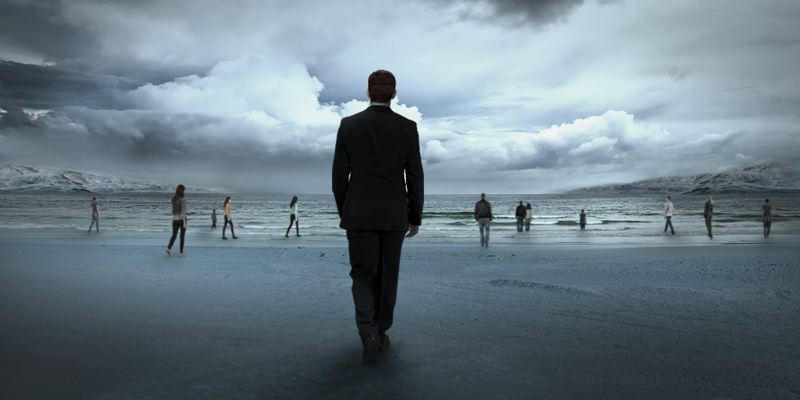
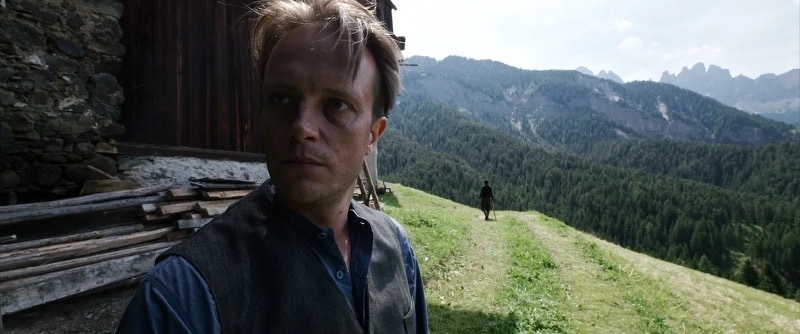
And from The Tree of Life on, Malick has contrasted beautifully composed widescreen images with handheld shots that place us “in the eye of the hurricane,” constantly swooping and diving: again, a way of expanding perspective.
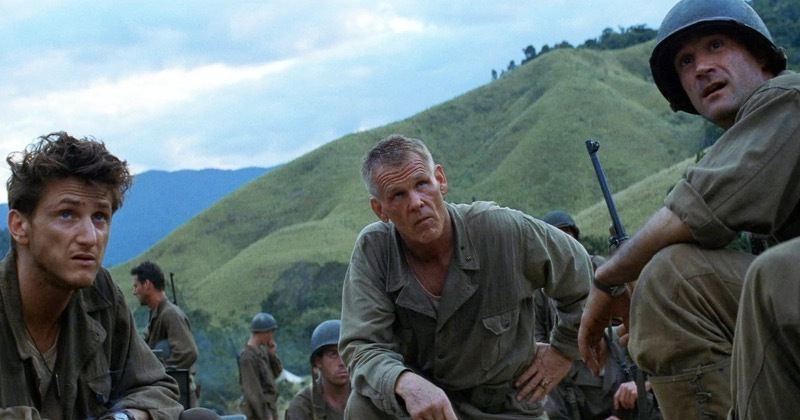
But Malick is concerned with perspective in a more metaphorical sense also. Consider The Thin Red Line. The novel by James Jones on which the film is based concerns not one or two soldiers, but rather C-for-Charlie Company: dozens of soldiers, many of which receive at least some focalization. Malick went into filming with a screenplay that followed Jones in showing the story from many perspectives, but with a few characters foregrounded, the most important of them being Corporal Geoffrey Fife (to be played by Adrien Brody). But as he filmed, his sense of narrative perspective altered, and Jim Caviezel’s Private Witt came to be the closest thing that the movie has to a central character. Not quite the protagonist — C-for-Charlie Company is the real protagonist — but close.
One might think of all this in terms of distribution of weight: our overall understanding of C-for-Charlie Company’s experience in the war is formed by the amount and kind of attention given to the various characters. A story in which Witt’s perspective predominates will feel different than one in which Fife’s does — or Sergeant Welsh’s, or Private Train’s.
I said that Malick’s sense of how his story should be weighted changed during filming, but a director’s final distributions of attention are determined during the editing process. Thus we have moved from Frame to Cut. Editing or “cutting” is done along three axes:
- What images do we see?
- How long do we see each of them?
- In what order do we see them?
Malick is famous for (a) shooting an enormous amount of footage and (b) taking a very long time to edit that footage into a feature-length film. Some of the challenges of getting it all done may be seen in this half-hour video about editing The Thin Red Line.
Or consider The Tree of Life. When Malick was working on an extended edition of the film for the Criterion release, Lee Kline of Criterion said that “the amount of footage that was shot for the movie was insane.”
There were pallets and pallets and pallets of footage in a warehouse in Valencia, Calif. where all the footage was put after the movie wrapped. Some of it was put away well, some of it wasn’t, so sometimes it took multiple tries to find the footage. It was in a box, it was on a reel, a shot that was at the end of a reel. It was like looking for a needle in a haystack, and it took months.
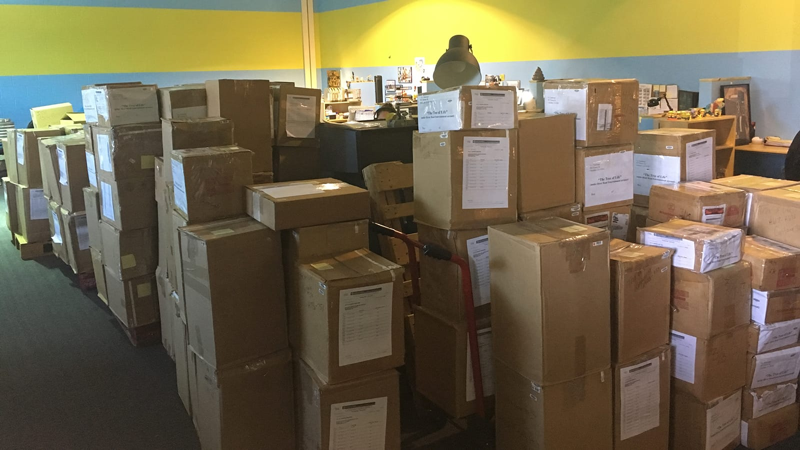
When Malick, working with Kline and others at Criterion, eventually put together a version fifty minutes longer than the theatrical release, everyone agreed that it was effectively a new movie.
Frame the images and cut them, and you have a story. Choose images differently framed and then cut them differently, and you have a different story. In Malick’s cinema, this is not relativism but rather an acknowledgement that human life is necessarily more complex and multilayered than any representation of it.
I think this is relevant in a distinctive way to the three films — The Tree of Life, To the Wonder, and Knight of Cups — that have been seen as autobiographical. It cannot be doubted that each film draws heavily on Malick’s own experience, in the contexts of (in order) family, erotic love, and vocation. But in each case we have a way of exploring Malick’s experience, not the way. If he were to make extended editions of To the Wonder and Knight of Cups, they would differ in interesting ways from the theatrical releases: they would offer different perspectives, in all the senses of that word.
In his great essay “From the Prehistory of Novelistic Discourse,” Mikhail Bakhtin says that parodies of serious works of art arise because that provides "the corrective of reality that is always richer, more fundamental and most importantly too contradictory and heteroglot to be fitted into a high and straightforward genre.” But parody is only one way of providing that corrective. When the director changes the framing, and the editors cut and re-cut along all three axes, new narratives emerge, and we are reminded that no one story can be the definitive account of what a person does and is. To acknowledge this is not to succumb to relativism, but to have the humility to understand that life is always more complex than our representations of it.
So framing and (especially) cutting are acts that have enormous implications: to say that through them you are “telling a story” is inadequate. You are finding a story, which means: achieving an understanding, an understanding of a life, or a set of lives, that can never be more than provisional — but typically (Criterion editions and director’s cuts are not universally available) you can only make one such understanding available to the public. I suspect that the responsibility accompanying the necessary decisions weighs heavily on Malick.
