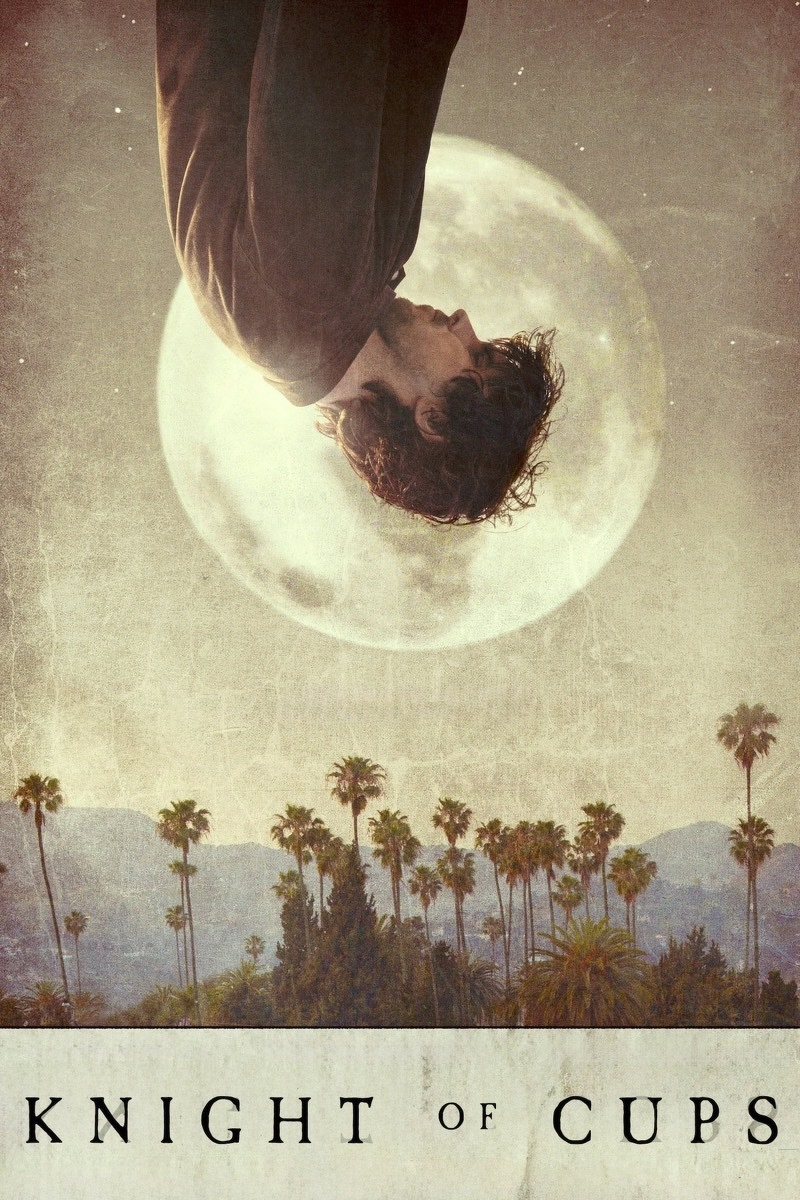
Returning to the theme of Malick as a contrapuntal filmmaker: We could say that To the Wonder, with its Neil/Marina/Jane theme and its Father Quintana theme, is a two-part invention, while Knight of Cups is a three-part invention. But the latter film — it was made right after Wonder — is contrapuntal in a different way. Here we are not dealing with two sets of characters in two different settings, but rather something more complex: three symbolic representations of a person’s life.
The notion that the essential shape of one’s life, the fundamental pattern that underlies one’s apparently chaotic experiences, might be discerned not by the logic of the left brain but by the various visionary experiences (dream, vision, symbol, image, music) of the right brain is perhaps the single most pervasive element of Cosmos Malick. William Blake once wrote to a friend,
What it will be Questioned When the Sun rises do you not see a round Disk of fire somewhat like a Guinea O no no I see an Innumerable company of the Heavenly host crying Holy Holy Holy is the Lord God Almighty.
That Blake might have been seeing what is really there is the possibility that, in his own distinctive way, Malick raises repeatedly in his films. Blake may be the one great artist most similar in spirit to Malick. Blake or Arvo Pärt. I think our current moment is one almost incapable of understanding Blake — I wrote about that here — and Malick is subject to similar failures of comprehension. Many future posts will explore these issues.
But this post will focus on Knight of Cups — and indeed, on just the words of the open sequence of the film. (Here I will say almost nothing about images or music.)
The three symbolic accounts are presented to us at the outset:
- Tarot (in the title)
- The Hymn of the Pearl (in a voice-over)
- The Pilgrim’s Progress (in another voice-over)
We are therefore given to understand before we are even introduced to our protagonist that we have three ways of representing or interpreting his experience. But what we cannot know is whether the three symbolic systems, as it were, are complementary — or whether, conversely, we must chose one as the primary, governing representation.
If our attention is directed at first towards Tarot, then we should take a good look at the Knight of Cups in that deck:
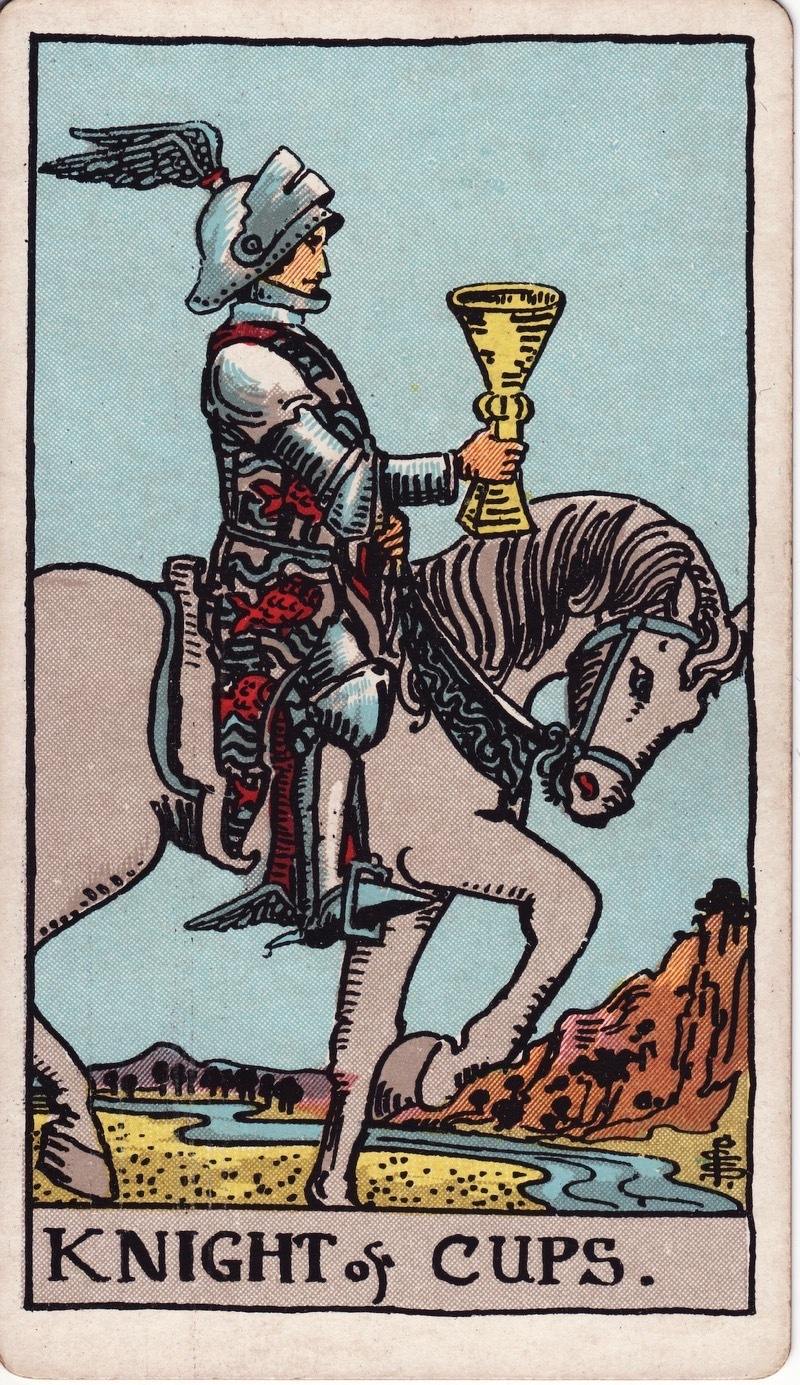
Note that the Knight is not rushing: his horse is walking, which enables the Knight to hold in firm balance his cup, keeping its contents — whatever they may be — safe. Commentators on the Tarot often note that the Knight of Cups is the least dynamic of the Knights, and yet he alone wears wings on his helmet and his shoes. This marks him as a Hermes figure, a messenger, and in Tarot tradition one who mediates between the unconscious and the conscious. It is noteworthy, then, that Rick, the protagonist of the film, is a screenwriter: a storyteller, which is to say, an interpreter of events and persons. So the first thing that the connection with Tarot does is to situate Rick vocationally.
It is important that Tarot cards, unlike the cards in a standard deck, are not reversible: they have a distinct rightside-up and upside-down. Readers of Tarot cards are divided on whether it matters that a card is laid down “reversed” (upside-down) but as far as I can tell most interpreters believe that a reversed card disrupts the reading: it suggests that there is some kind of blockage or impediment in the life of the person whose story is being interpreted — and often that that impediment is internal, caused by some mental or spiritual maladjustment rather than by circumstances. Therefore we should take particular note that the film’s poster shows Rick upside-down. He is not just the Knight of Cups, but the Knight of Cups reversed.
But hang on a minute … should our attention go first to Tarot? Other things are going on early in the movie. We see that the movie is called Knight of Cups, but that Tarot is going to be an organizing principle in the film is not clear until other cards start showing up, for instance:

At the outset two other symbolic structures are present. For one thing, we see scenes of childhood (filmed on grainy stock that looks like a home movie) accompanied by a narration from a person whom we later learn is Rick’s father, who recalls — and I punctuate and lineate to follow the rhythm of the narration —
the story I used to tell you when you were a boy
about a young prince, a knight,
sent by his father,
the king of the East,
West to Egypt
to find a pearl,
a pearl from the depths of the sea.
But when the prince arrived
the people poured him a cup that took away his memory.
He forgot he was the son of the king.
Forgot about the pearl.
And fell into a deep sleep.
The king didn’t forget his son.
He continued to send word.
Messengers.
Guides.
But the prince slept on.
And as we hear these words, we see Rick at a party: “the depths of the sea” become a swimming pool, the cup of forgetfulness a series of cocktails. (Note that here is is not the bringer of a cup but the receiver, not the bringer of a message but the unwitting object of one.) Rick drives, dances, plays, kisses … but he is sound asleep.
Thus “The Hymn of the Pearl.” But something happens even before this. The first words we hear, words that begin even before the title, even before the film’s first image, are these:
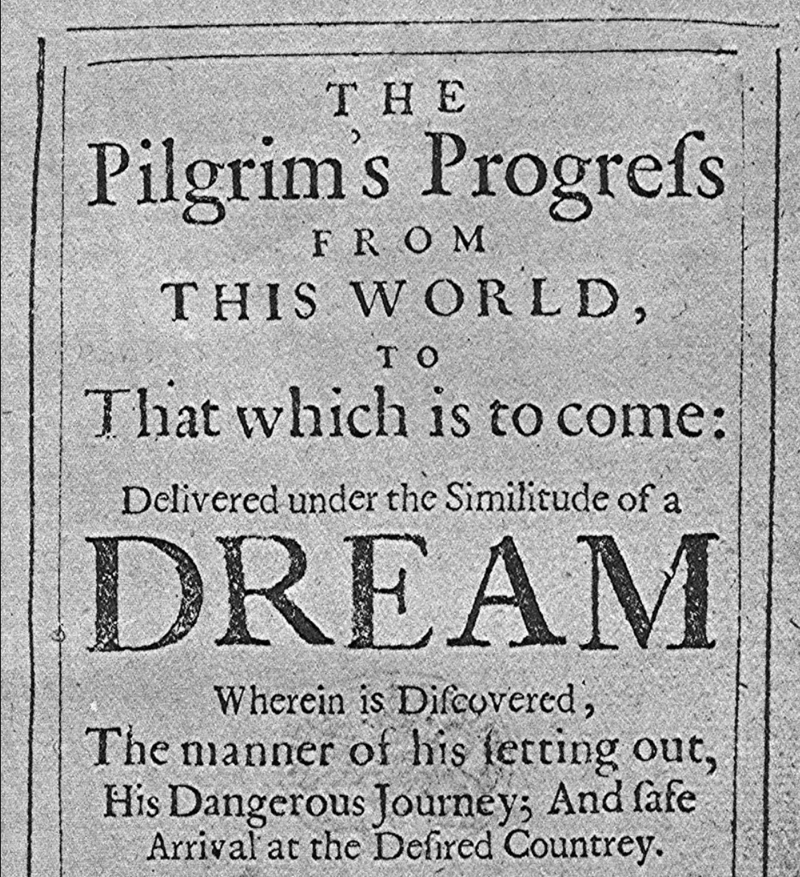
These words are followed by the opening words of Bunyan’s book:
As I walked through the wilderness of this world, I lighted on a certain place where was a Den, and I laid me down in that place to sleep: and, as I slept, I dreamed a dream. I dreamed, and behold, I saw a man clothed with rags, standing in a certain place, with his face from his own house, a book in his hand, and a great burden upon his back.
The narrating of these words by Sir John Gielgud allows us to discern that we are hearing the beginning of Ralph Vaughan Williams’s The Pilgrim’s Progress: A Bunyan Sequence. (Vaughan Williams spent many years trying to put this work together: see details here.)
So our attention is not directed first to Tarot, nor the “Hymn of the Pearl,” but rather to Bunyan. And if we notice that, we might also notice that though we are carried through most of Rick’s story by a series of title cards taken from the Tarot, the final title card does not come from the Tarot:

Let the reader take careful note: Tarot is neither the opening nor the concluding symbolic structure. As I said, the Tarot decks situates Rick vocationally, and in his passage through the public world; but I would argue that the Hymn of the Pearl helps to situate him familially, as a son and brother; and Pilgrim’s Progress places him spiritually, as a man bearing a great burden who must leave the City of Destruction in order to rid himself of that burden.
So let’s conclude this exercise — there will obviously be much to say about this movie in later posts, perhaps, who knows, over a period of several years — by simply noting the words of the opening sequence, in order:
- Gielgud’s recitation of the title page and opening sentences of The Pilgrim’s Progress.
- The title of the movie.
- Rick in a muted, near-whispering voiceover: “All those years … living the life of someone … I didn't even know.”
- His father remembering how he told young Rick the story of “The Hymn of the Pearl.”
We are now ready to begin.
