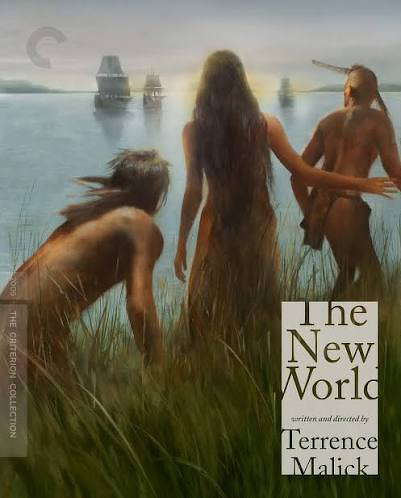
The Criterion edition of Malick’s The New World is on 3 discs, and the 3 discs are
- What’s called the First Cut (150 minutes) — that was what was originally shown to selected audiences and at the official premiere. But in fact, on the very day that that cut premiered that Malick and his editors got the news that they needed to cut 15 minutes from the film for general release. The editor Mark Yoshikawa remembers watching the premiere with a notebook in his hand, so that he could identify passages to eliminate. But then, he says, when he met with Malick the next day to begin that process, Malick’s suggestion was that they not think of this new, unexpected job of editing simply as a way to shrink what was already there. Instead, he wanted Yoshikawa to see it as an opportunity to create a different movie — one that had a different weight, a different shape.
- That “new film” became the Theatrical Cut (135 minutes) — Disc 2.
- And that let’s-make-a-new-movie attitude continued when, later on, they made the Extended Cut (172 minutes) — Disc 3.
Now, to be clear, the basic structure, the basic framework of the story is always the same:
- English people arrive in what we now call Virginia and begin to build a a village there;
- One of them, a troublemaker named John Smith, is kidnapped by the local people, the Powhatan, and gradually becomes accepted as a kind of add-on to their community — not fully a member, but someone whose presence is welcome;
- He and the chief’s daughter (in the credits she’s called Pocahontas, though that name is never used in the film itself) fall in love;
- He is sent back to Jamestown, where he becomes the leader of the nearly moribund colony;
- The princess is exiled from her people and comes to Jamestown, where she is reunited with Smith;
- He decides to leave the colony in order to lead, at the request of King James I, a mission to the East Indies;
- Soon after his departure the princess is told that he has died, and she goes into a deep depression from which she is only gradually rescued by the love of another colonist, John Rolfe;
- The princess (now given the Christian name Rebecca) marries Rolfe, nears him a son and eventually goes with him to England, where she is welcomed at Court and sees John Smith for one last time;
- But before the family can return to Virginia, Rebecca dies and is buried in England;
- After which her husband and son return to Virginia.
But within that basic shape, there’s a lot editors can do to alter what our attention is called to, and alter what the experience of the film is — especially when they have dozens and dozens of hours of film, so much film that when shooting was still going on Kodak sent Malick a case of champagne to thank him for being one of their best customers ever.
In an earlier post I wrote:
Terrence Malick finds the problem of perspective endlessly fascinating and challenging, and most of his experiments in cinematic storytelling are meant to address this problem. For introductory purposes, we can subdivide his strategies into two categories: Frame and Cut.
Now I want to add another element of Malick’s presentation of perspective — one that I don’t have a short name for, or any name at all, really. But whatever we might call it, it’s important. According to Yoshikawa, one of the things Malick was most interested in doing as he made the extended cut of The New World was to increase the subjectivity — increase the amount of time we spend in the mindspace of the characters. How do they see, how do they encounter the world?
Yoshikawa calls attention to a scene where John Smith is getting ready to leave, and he’s talking with the other colonists, but he’s also reflecting about the choice he’s making. So you hear a voiceover of what he’s saying to himself, interspersed and sometimes overlapping with what he’s saying to those around him. Throughout the scene, though we see everybody from the outside — that is, we’re looking at John Smith through the same camera lens that’s used to show the other colonists — we’re half-immersed in this “objective” representation of reality, and half-immersed in John Smith’s mental space. The theatrical cut has a lot more of that subjectivity.
And that kind of phenomenological approach — What does it feel like to be within this person’s perceptual world, this person’s sensorium? — is essential to Malick’s cinema, especially from The Thin Red Line onward. I get the sense that Malick would like to, if he could, bring smell and taste and touch to this world, and not just be confined to seeing and hearing, to throw us into the mental and perceptual and sensory experience of the characters, but without ever losing sight of the great Creation in which we all equally participate.
In the last minutes of the film, we see Pocahontas/Rebecca — I will still call her the princess — in the garden of an English country house on a day of cloud and mist and rain. She and her son play hide-and-seek; the little boy runs around the elegantly clipped hedges of the house’s garden, and we follow him as he runs in delight.
The technique here is interesting: the boy is filmed by a cameraman with a Steadicam, almost certainly Jörg Widmer, with the camera positioned at the boy’s height. In other words, the scene is filmed in precisely the same way that Kubrick filmed Danny’s flight through the maze at the end of The Shining. (I have no idea whether Malick was aware of this.) But there a small child fled in terror from a murderous father; here a small child trots with delight, laughingly pursued by a loving mother.
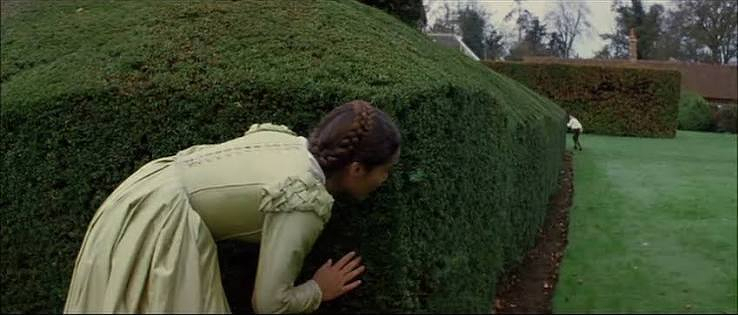
Something has happened to the princess: her meeting with John Smith — which is very beautiful, for for Smith deeply melancholy — has in effect ended, for her, the story of their relationship. John Rolfe is no longer the man she married only because she thought John Smith dead: he is the man she married, and she settles into his embrace: the two of them and their child are one family.
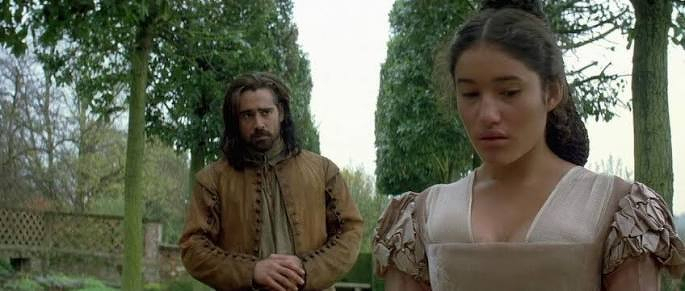
And it is when she gives herself to this life that something else happens: she realizes, with a sudden and great joy, that the Mother to whom she had always prayed and given thanks, the Earth herself, is not lost to her, not even across the great sea in a strange new world. (That great mother — Nokomis — is not God the creator — Manitou — but is rather what we might call Mother Earth, what Auden liked to call Dame Kind.)
As the rain falls upon the princess she welcomes it again, as she had always done, as the Mother’s gift. And through the magic of the movies, we get to share in this experience of a whole person, mind and heart and sensorium. Malick has found here a language of pure subjectivity — but it is a subjectivity we are invited to enter.
