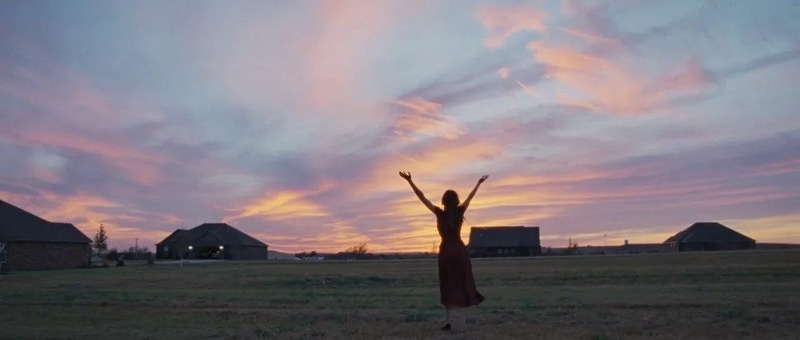
The greater World is called Cosmus from the beauty thereof.
— J. Bulwer, Anthropometamorphosis (1650)
Were it not for the indwelling reason the world would be a chaos and not a cosmos.
— J. S. Blackie, On Self-culture (1874)
Sensations which do not amount to perceptions, make no lodgment in the cosmos of our experience, add nothing to our knowledge.
— T. H. Green, Prolegomena to Ethics (1882)
By calling this site Cosmos Malick, I mean to suggest that Terrence Malick’s films visualize, articulate, and participate in a … well, a cosmos: a coherent, non-chaotic world, a world both intelligible and sensible. But in trying to give you a picture of this cosmos, I am hampered by having words as my primary instrument.
To be sure, Malick is a skilled and imaginative wielder of words himself: he writes the screenplays for all his films. But his process, while it begins in ordinary ways, soon becomes extraordinary.
It is standard practice in American filmmaking for a writer to register his or her script with the Writer’s Guild, and to do this before production begins. This practice was established when writers were regularly being denied credit for their work by the big Hollywood studios; to have their scripts registered prevented such poaching and gave them strong evidence if they needed to take rapacious moguls to court. Malick begins the making of a film by writing a script and registering it, and those registered scripts tend to find their way onto the internet. Do a couple of searches and you’ll see what I mean.
But here’s the thing: Malick’s finished films are always, and I mean always, radically different from the registered scripts. I happen to own a copy of a complete screenplay that Malick wrote many years ago for a film he never made, and while I do intend to write about it at some point because of its intrinsic interest, there is no reason to believe that, if Malick had ever made the film, anything more than a fraction of the existing words would have been used.
And not only are the words of a released Malick film different from the words of the registered script, they are also fewer in number. A script for Malick functions more like a treatment that an actual script, though of great size: it’s an enormous outline, or set of general directions, subject to major revision and reworking during filming. Starting no later than The Thin Red Line, Malick would show up on the set on a given morning of shooting with multiple pages of new dialogue, new ideas, meditations on character, to hand to the actors in the scenes to be filmed that day: he would have typed these out either after shooting the previous day or (more commonly, I believe) first thing in the morning. And often the purpose would be to replace the words that had previously been written with gestures, facial expressions, or simply other and fewer words.
(Brooke Adams on filming Days of Heaven, Malick’s second movie: “The script — when I finally actually got to read it — read like a Thomas Hardy novel. It was absolutely gorgeous. And when we started rehearsing it, we were rehearsing it in the hotel in Alberta, Canada — for a week, maybe, we rehearsed, which is already more than you usually get to do in a film. Every time we’d say lines, Terry would say, ‘Oh God, no, I don’t believe that. Cut it.’ And so he just kept cutting our lines.”)
One point rarely noted about Malick’s famous voiceovers is how spare they are, how few words the actors say. (The chief exceptions that come to mind are Linda Manz’s fabulously baroque apocalyptic vision at the end of Days of Heaven and the interior monologues of Father Quintana in To the Wonder.) Consider the topic of my previous post: the voiceovers — spoken by Sir John Gielgud, Brian Dennehy, and Christian Bale — in the opening minutes of Knight of Cups. Just a few dozen words, but accompanied by an extraordinarily wide-ranging series of still and moving images, undergirded by a powerful soundtrack. The words are beautiful and well-chosen, but they carry only a small part of the emotional and affective weight of the scenes in which they appear.
My point is that when I am trying to describe Cosmos Malick I am working with limited and inadequate resources. I will be trying as this site grows to get better at this task, but I will, I think, always be tempted to say: Just go watch the movies, for heaven’s sake! But if you look back at what I have written so far, what is the Cosmos that I have described? What does the story so far add up to?
I’d summarize it by making two points.
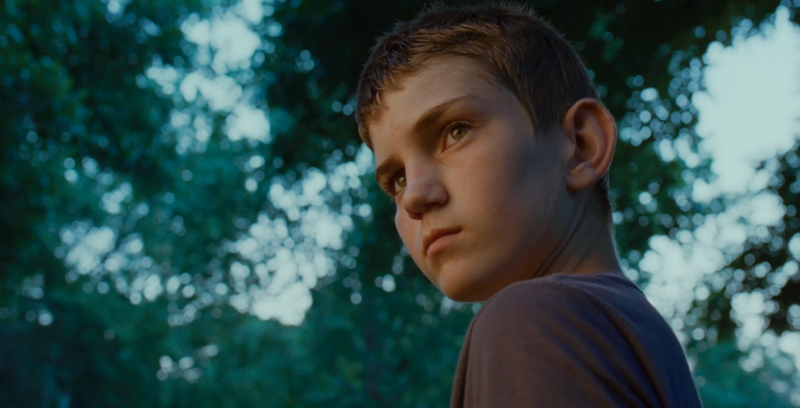
First, as Malick’s career has developed, he has moved towards wider and wider lenses: at this point he’s actually gotten down below 10mm. The primary effect this enables is to have (sometimes extreme) close-ups on faces that also show us the world within which those faces are placed.
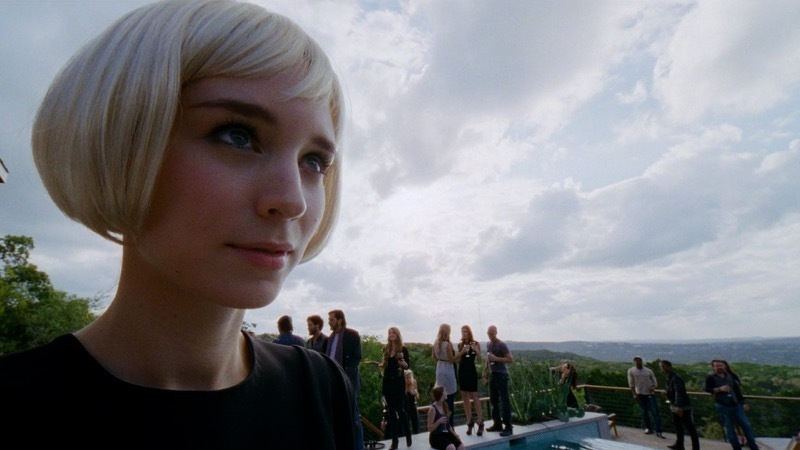
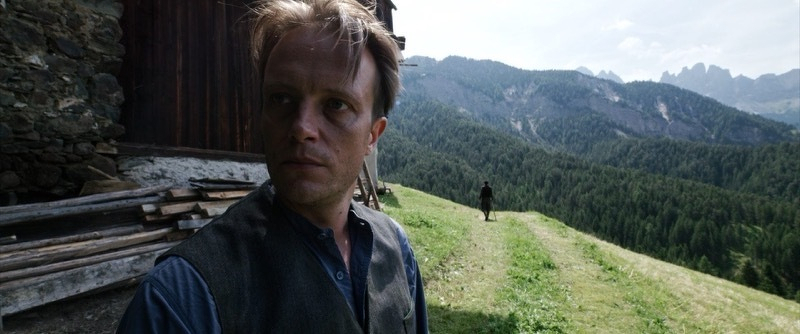
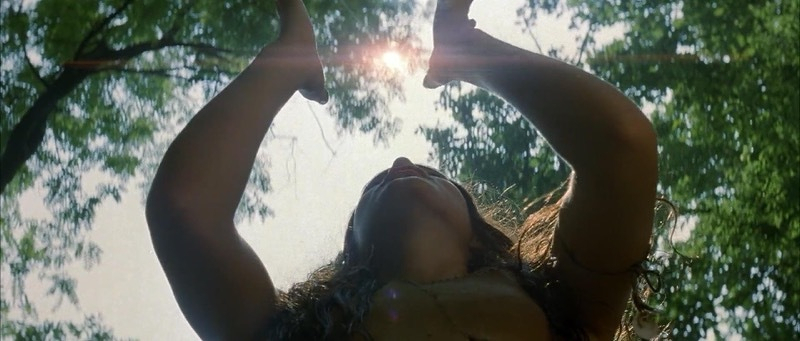
Here I think of a beautiful passage from Auden’s “Prime” on waking up:
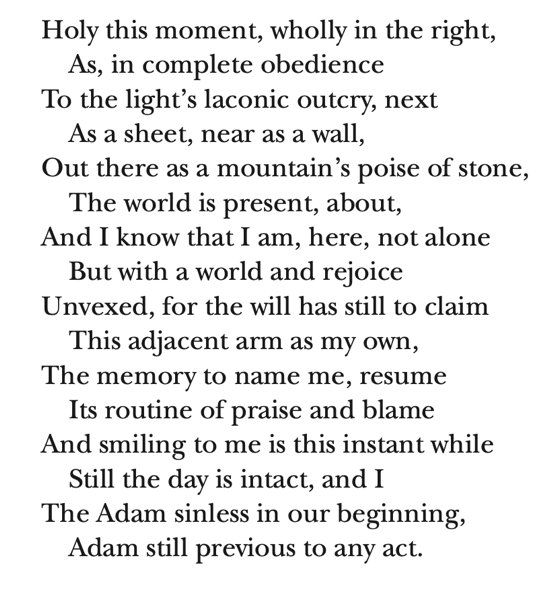
“Not alone / But with a world.” But as Private Train reminds us, in this world there seems to be “a war in the heart of nature.” If this world is not causeless but created, if it is Cosmos rather than Chaos, then what does this constant struggle tell us about the Creator? Whatever it tells us, it cannot be wholly comforting. Here I find myself thinking about the one work of art that I believe to be most similar in temper and vision to Malick’s movies, and that is G. K. Chesterton’s The Man Who Was Thursday. I think especially of this passage:
“Listen to me,” cried Syme with extraordinary emphasis. “Shall I tell you the secret of the whole world? It is that we have only known the back of the world. We see everything from behind, and it looks brutal. That is not a tree, but the back of a tree. That is not a cloud, but the back of a cloud. Cannot you see that everything is stooping and hiding a face? If we could only get round in front — ”
So I would say that Cosmos Malick starts with these fundamental, governing apprehensions: that we are not alone, that we wake into a world — but that world offers ambiguous testimony to its own character. There is a war at the heart of nature; but if we look and listen with sufficient attention, we may discern also the way of grace. We may, we just may, be able, eventually, to “get round in front” and see the face of the world.
